 Voceris
The voice training app that shows you how you sound.
Read a short prompt out loud. Voceris scores your depth, clarity, pace, fillers and 5 more measures, gives you a tier from D to A+, then a 5‑minute daily plan to raise it.
 Scan with your iPhone camera
Free download for iPhone and Android, or use it in your browser. Your first voice score is free; full analysis and training with Voceris Pro.
A flat line sounds bored. A moving one sounds alive.
People judge your voice before you finish saying hello.
In one study, listeners rated strangers on trustworthiness and dominance from a single recorded "hello", about half a second of audio, and largely agreed with each other. Your voice is doing work for you, or against you, in every call, meeting and first date. The good news: most of what they hear is habit, and habits train.
McAleer, Todorov & Belin (2014), "How Do You Say 'Hello'? Personality Impressions from Brief Novel Voices", PLOS ONE.Nine measures. One honest score.
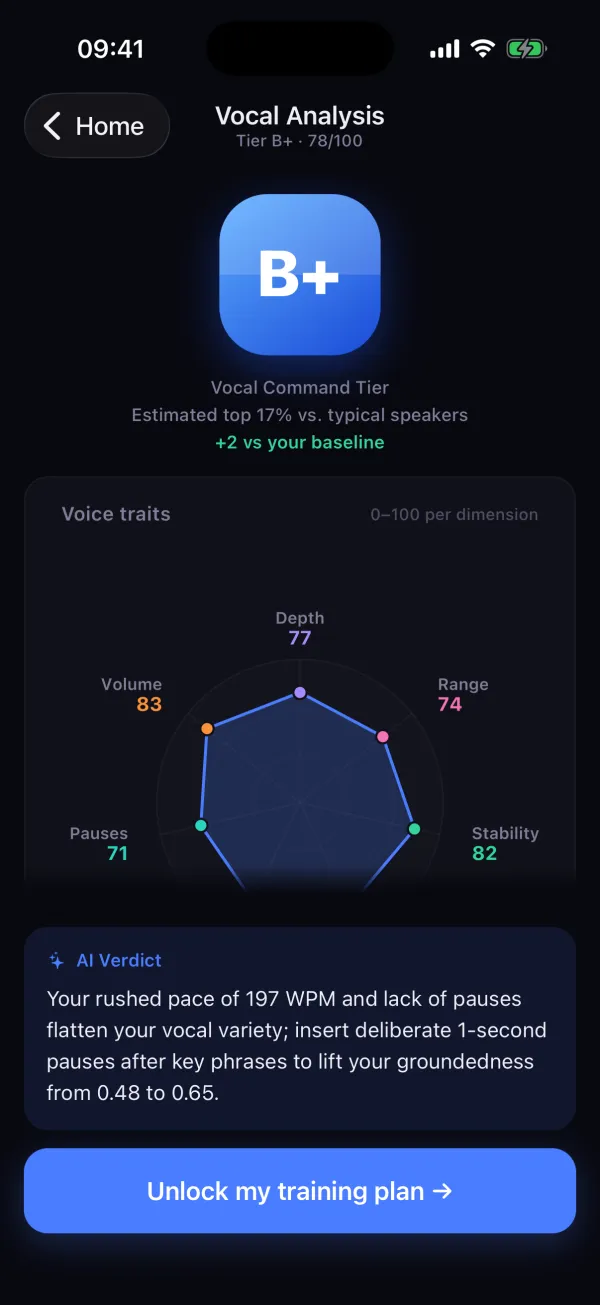
Every recording is scored 0–100 on the things vocal coaches listen for. These are example scores from a B+ speaker.
- Depth 77
- Where your pitch sits. Thin and high-strung, or grounded and relaxed.
- Resonance 78
- How full your voice sounds: chest-led and rich, or flat and nasal.
- Clarity 80
- How cleanly words land: articulation, breathiness and mumbled endings.
- Stability 82
- Whether your voice holds steady or wobbles and trails off when you're nervous.
- Pace 76
- Your words per minute. Rushing sounds anxious; a measured pace sounds in control.
- Pauses 71
- Whether you use silence on purpose, or run every sentence into the next.
- Fillers 79
- How often "um", "like" and "you know" sneak in.
- Vocal fry 74
- The creaky rasp at the ends of sentences that drains authority.
- Volume 83
- Projection and control: loud enough to own the room, without shouting or fading.
- B+
Your scores roll up into an overall score out of 100, a tier from D to A+, and an estimated percentile against typical speakers.
Train your voice in five minutes a day.
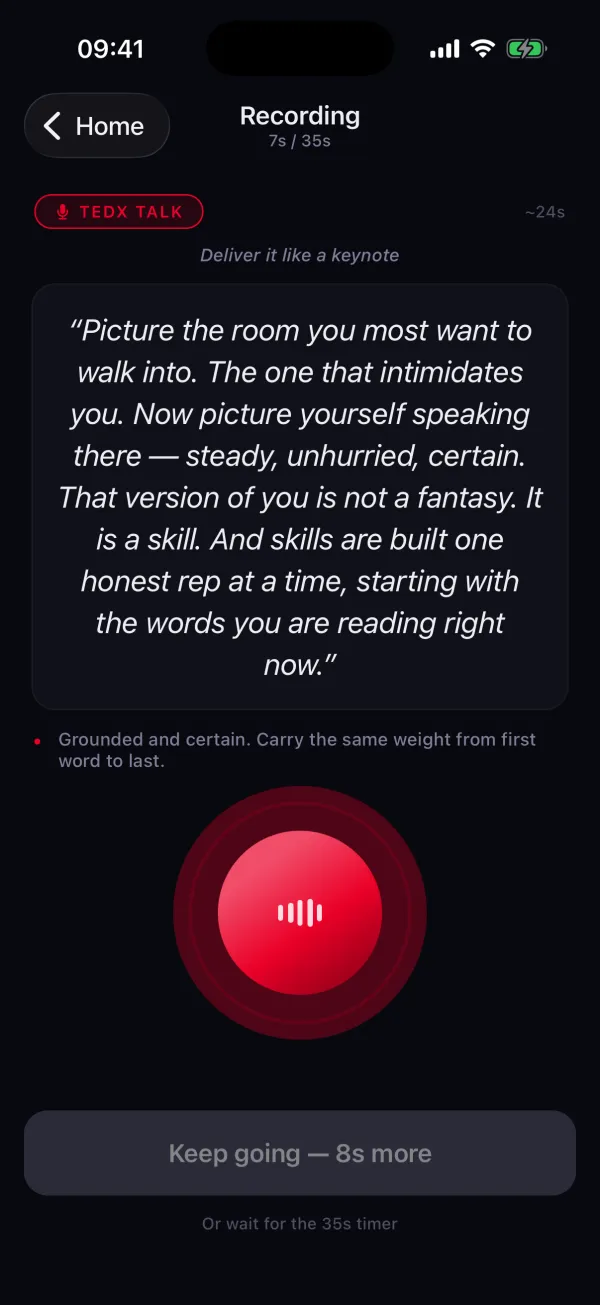
Record
Read a short prompt out loud for 15 to 35 seconds. Prompts match your goal.
Get your read
Your tier, 9 scores and an AI coach's verdict on what to fix first.
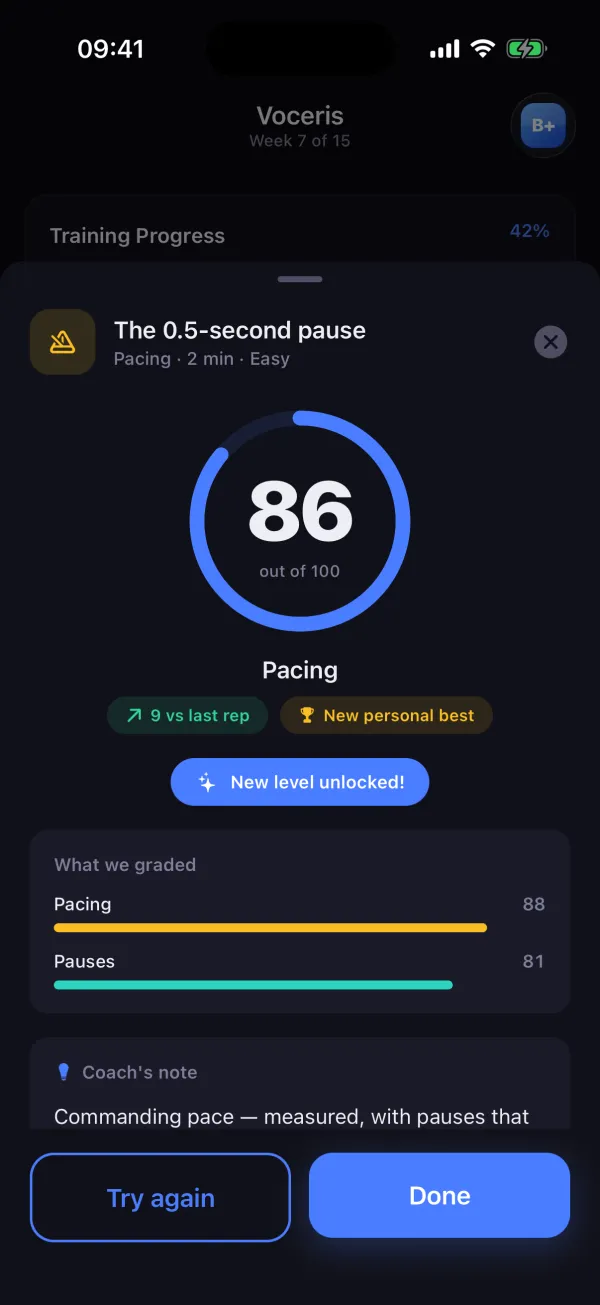
Train
A 1-minute warm-up and a short drill aimed at your weakest measure, from a library of 65. Every rep is scored.
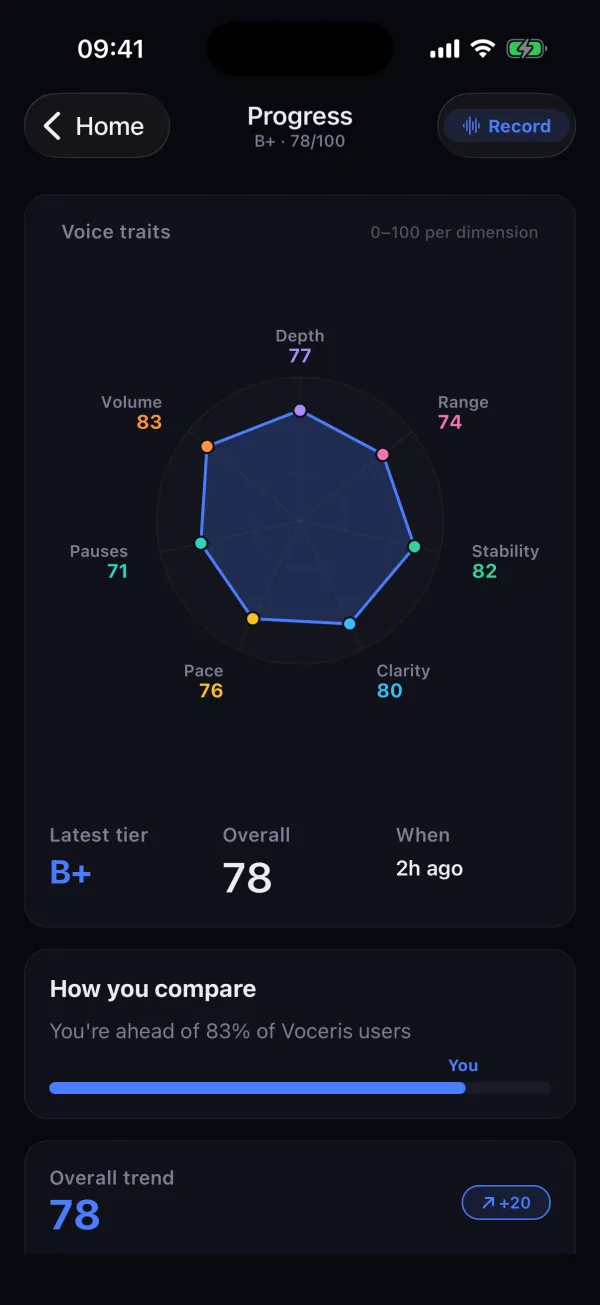
Re-record
Record again and watch your scores, tier and streak climb on your progress chart.
Built around what you want your voice to do.
Pick a goal and Voceris weights your scores, prompts and plan around it.
- Dating
Sound warm, grounded and present from the first hello, on calls and voice notes too.
- Public speaking
Lose the shaky voice and the rushing. Pause, project and hold a room.
- Work & leadership
Bring more presence to meetings, pitches and interviews.
- Content & podcasting
Keep listeners hooked with pace and range that stop the scroll.
- Singing
Build resonance, breath support and pitch control.
How Voceris compares.
| Voceris | Singing apps | Private vocal coach | |
|---|---|---|---|
| Built for | Your speaking voice: dates, meetings, stage, camera | Hitting notes in songs | Whatever you book them for |
| Feedback | Scores in seconds, every time you record | Pitch accuracy on notes | Detailed, but only during sessions |
| Daily practice | About 5 minutes a day, picked from your weak spots | Vocal exercises and scales | Homework between lessons |
| Tracks progress | Every measure, with personal bests and streaks | Usually per exercise | Coach's notes |
| Cost | Free first score, then a subscription | Free to subscription | Often $60–150 per hour |
Free voice guides.
Exercises you can start today, with or without the app.
- High pitched voice: why you sound squeaky and how to speak lowerMost high pitched or squeaky voices are not set by anatomy alone.
- Charisma training on Android: 5-minute daily voice drillsCharisma in speech comes from variation: pitch that moves with meaning, deliberate pace, clean pauses, and enough volume to fill the room.
- Voice training app for Android: how Voceris works on Google PlayVoceris is available on Android from Google Play (package com.voceris.app) for Android 7.0 and later.
- How to sound confident in a job interview: voice and deliveryInterview nerves tighten the throat, lift the pitch, speed up the pace and increase filler words, which is exactly the profile interviewers read as unsure.
- Vocal resonance exercises: how to speak with a fuller voiceResonance is how your throat, mouth and nasal cavities amplify and colour the sound your vocal folds make.
- Articulation exercises: 10 drills by sound and a 5-minute routineArticulation exercises are short speech drills that train your lips, tongue and jaw to form each sound precisely.
- Average voice pitch: men, women and children in Hz and musical notesThe average adult male speaking voice is about 115 Hz, near the note A#2, and the average adult female speaking voice is about 199 Hz, near G3, according to a study of 379 adult speakers of Australian English reading aloud.
- Charismatic voice: what listeners respond to and 5 drills to build itA charismatic voice is an expressive one: its pitch, pace and volume change with the meaning of what you are saying.
- Head voice vs chest voice: what chest voice is and how to train itChest voice is the fuller register you probably speak in, with thicker vocal fold vibration and firmer contact.
- How to speak from your diaphragm and chest: 8 timed drillsTo speak from your diaphragm, breathe in low so your belly and lower ribs expand, then let the air out steadily while your throat stays relaxed.
- How to stop mumbling: find your type, then fix it with 6 drillsMumbling means speaking quietly and indistinctly with little mouth movement, so listeners cannot catch your words.
- Phone voice: why you have one and how to sound professional on callsA phone voice is the slightly more formal, careful or higher voice many people switch to on calls, usually to sound polished to someone who cannot see them.
- Quiet voice: why your voice is weak and a 4-week plan to speak louderA quiet or weak voice usually comes from a low volume habit, shallow breathing or a reluctance to take up space, and those respond well to short daily practice.
- Radio voice and podcast voice: what makes them work, with drillsA radio voice comes less from natural depth than from speaking close to a directional mic, in a quiet, soft room, with an unhurried, conversational delivery aimed at one listener.
- Raspy voice: what it means, how to get one safely, how to lose itA raspy voice is a rough, grainy or breathy sound, usually because the vocal folds are irritated or swollen or are not closing evenly.
- Reading aloud practice: 10 original passages and a voice sample scriptReading aloud practice works when you record yourself, mark your breaths and fix one thing per take, rather than simply getting through the words.
- Upspeak: meaning, examples and how to stop itUpspeak, also called uptalk or high rising terminal, is ending a statement with a rising pitch so that it sounds a little like a question.
- Voice analyzer: what it measures, healthy ranges and free toolsA voice analyzer is software that measures your voice from a recording, typically pitch, pitch range, volume, speaking rate, pauses, filler words and voice-quality values such as jitter and shimmer.
- Voicemaxxing: what works, what is nonsense and a safe routineVoicemaxxing is the online trend of deliberately training your voice to sound deeper, stronger or more attractive, usually aimed at young men.
- Why do I hate my voice? Why recordings sound wrong and what helpsYou probably hate your recorded voice because it is not the voice you know.
- Why does my voice crack? Causes by age and how to stop itYour voice cracks when your vocal folds suddenly change how they vibrate, usually because of puberty, a jump between registers, tension from nerves, dryness or tiredness.
- How to make your voice deeper (naturally): 7 exercises that workYou cannot change the size of your vocal folds, but most people speak above their most comfortable pitch because of tension, shallow breathing and habit.
- How to make your voice more attractive: what research shows and what you can trainResearch links voice attractiveness partly to pitch, with listeners on average preferring somewhat lower pitch in men's voices and somewhat higher pitch in women's, but warmth, relaxed breathing, steady pace and a smiling, engaged tone are the parts you can actually train.
- How to project your voice without shouting: 7 exercisesProjecting your voice means being heard clearly at a distance without pushing from the throat.
- How to sound more confident when speaking: what listeners actually hearListeners judge confidence mostly from delivery: a steady, unhurried pace, deliberate pauses instead of fillers, sentences that end on a falling note rather than rising like questions, and enough volume to be heard without strain.
- How to speak more clearly: 8 exercises to stop mumblingMost unclear speech comes from four habits: talking too fast, barely opening the mouth, swallowing the ends of words and speaking too quietly.
- How to stop saying um: a practical plan to cut filler wordsFiller words like um and uh are signals that you are still planning what to say, so the fix is not willpower but replacing the sound with a silent pause.
- How to stop sounding monotone: 7 exercises for a more expressive voiceA voice sounds monotone when pitch, stress, pace and volume barely change, so every word gets the same weight.
- The best voice training apps for speaking (not singing) in 2026If you want to change how your speaking voice sounds (depth, resonance, vocal fry, steadiness), choose an app that scores the voice itself, such as Voceris or Vocal Image.
- Vocal fry: what it is, when it matters and how to fix itVocal fry is a low, creaky way of producing sound that usually appears when breath and volume run out, especially at the ends of sentences.
- Best public speaking apps in 2026: 8 AI speech coaches comparedFor most individuals, Speeko is the best all-round public speaking app, with delivery feedback, lessons and AI roleplays on iOS, Android, Mac and the web.
- BoldVoice alternatives: 6 accent training apps compared (2026)The closest BoldVoice alternative is ELSA Speak, which gives AI pronunciation feedback with a choice of American, British or Australian English and adds grammar, vocabulary and exam prep.
- ELSA Speak alternatives: 6 English speaking apps compared (2026)ELSA Speak is a strong all-round app for English pronunciation: it scores sounds and word stress, lets you choose an American, British or Australian accent, and adds grammar, vocabulary and exam prep.
- How to be more articulate: think clearly, then speak clearlyBeing articulate has two halves: organising your thoughts so your point comes first and each sentence carries one idea, and pronouncing your words so they arrive complete.
- How to improve communication skills: 12 habits that make people listenTo improve your communication skills, work on three things: say one clear point with a reason and an example, deliver it at an unhurried pace with pauses and a steady voice, and listen well enough to summarise the other person's view before you reply.
- How to improve your speaking voice: the 9 qualities to trainYou improve your speaking voice by training habits, not by changing your anatomy: breathe low, relax the throat, open the mouth, finish your words, slow down, pause between ideas and keep your volume to the last word.
- How to overcome fear of public speaking and stop your voice shakingFear of public speaking, sometimes called glossophobia, is a normal stress response: adrenaline speeds up your heart and breathing, dries your mouth and tightens the muscles around your voice, which is why it shakes.
- How to speak English fluently and confidently: 7 daily drillsListeners judge how fluent and confident you sound in English mostly by your delivery: a steady pace, pauses between ideas instead of um and uh, falling sentence endings and enough volume.
- How to speak slower: 8 drills to stop talking so fastTo speak slower, add pauses before you try to slow the words themselves: stop at every full stop, say one idea per breath and land the last word of each sentence.
- Nasal voice: why you sound nasal and 8 drills to fix itA nasal voice is either hypernasal (too much sound resonating in the nose, a twangy or whiny tone) or hyponasal (too little, the blocked, stuffy sound of a cold).
- Orai alternatives: 5 public speaking and voice apps compared (2026)If you like Orai's delivery feedback but want courses or conversation practice, Speeko is the closest alternative.
- Public speaking tips: 21 ways to sound confident and hold attentionThe public speaking tips that make the biggest difference are about delivery: build the talk on three points, rehearse it out loud and record it, and warm up your voice before you start.
- Speeko alternatives: 6 public speaking apps compared (2026)The closest Speeko alternative is Orai, which scores filler words, pace, clarity, energy, confidence and conciseness on iPhone, Android and the web.
- Tongue twisters: 60 to improve your diction, from easy to hardestTongue twisters improve diction by forcing your lips, tongue and jaw to switch quickly and precisely between similar sounds.
- Vocal Image alternatives: 5 apps to train your speaking voice in 2026The closest Vocal Image alternative for the sound of your voice is Voceris, which scores 9 speaking-voice measures per recording and builds a 5-minute daily plan, on iPhone, Android and in the browser.
- Vocal warm-ups: a 5-minute routine before you speak or singA good vocal warm-up takes about five minutes: loosen your body and jaw, take a few slow low breaths, do gentle semi-occluded exercises such as straw phonation, lip trills or humming, glide through your range with sirens, wake up your lips and tongue with tongue twisters, then say your opening lines out loud.
- Voice exercises for speaking: 15 drills for a stronger, clearer voiceThe most useful voice exercises for speaking train six skills: breath support, resonance, pitch range, articulation, projection and pace.
- What is my vocal range? How to find your range and voice typeYour vocal range is the span from the lowest to the highest note you can sing with a steady, comfortable tone, written as two notes (such as A2–A4) or counted in semitones and octaves.
- Words per minute speaking: average rates and a speech length chartMost guides put conversational English at roughly 120 to 160 words per minute (wpm) and recommend about 130 to 150 wpm for presentations, while studies of relaxed phone conversations measure faster, around 170 wpm on average.
- Yoodli alternatives: 6 AI speech coaches compared (2026)The closest Yoodli alternative for individuals is Speeko, which pairs delivery feedback with AI roleplay conversations in a phone app.
All guides, the free voice pitch test, speaking rate test or vocal range test
Questions, answered.
How do I train my voice?
Start by hearing how you sound now. Open Voceris on your phone or in the train my voice web app, read a short prompt for 15 to 35 seconds and get a score for 9 voice measures. Then practice about 5 minutes a day: a 1-minute breathing warm-up and a drill aimed at your weakest measure. Record again every few days to see what changed.
What is the best voice training app for speaking?
Most voice training apps are built for singing. If you want to improve how you sound when you talk (on dates, in meetings, on stage or on camera), look for an app that measures your speaking voice, shows you specific weak spots and gives you short daily exercises with feedback. Voceris is built for exactly that: it scores 9 measures of your speaking voice from a short recording and builds a daily training plan around your lowest scores.
Can you actually train your voice to sound more confident?
Yes. Pace, pauses, filler words, vocal fry, volume control and breath support are habits, not fixed traits. Like any skill, they change with short, regular practice and feedback. Voceris gives you that feedback by scoring every exercise rep and re-scoring your voice when you record again.
How does Voceris analyze my voice?
You read a short prompt out loud for 15 to 35 seconds. Voceris measures your pitch, resonance, steadiness, speaking rate, pauses, filler words, vocal fry and volume, scores each from 0 to 100, and combines them into an overall score and a tier from D to A+. An AI coach then writes a short verdict explaining what is holding you back and what to fix first.
Is Voceris free?
Your first recording is free: you get your tier from D to A+, your overall score out of 100 and an estimated percentile compared with typical speakers. The full breakdown of all 9 voice measures, the AI verdict, the training plan and daily drills are part of Voceris Pro, an auto-renewing subscription with a 7-day free trial. The separate voice pitch test on this site is free with no account.
How much does Voceris cost?
Voceris is a free download on the App Store and free to open in your browser, and your first voice score is free. The full analysis and the training plan are part of Voceris Pro, an auto-renewing subscription that starts with a 7-day free trial. The price is shown before you pay. You can manage or cancel it any time in your Apple ID settings. If you subscribe in the web app, billing is handled by Stripe and you manage it from Settings, Manage Subscription.
How long is the training plan?
Between 30 and 180 days, sized from your first analysis: the further you have to go, the longer the program. Each day takes about 5 minutes, usually a 1-minute breathing warm-up and a 3 to 4 minute drill. When the program ends, you move to a lighter maintenance routine.
Can Voceris make my voice deeper?
Voceris includes resonance and breath exercises that help you speak from a lower, more relaxed placement, which most people hear as a deeper, fuller voice. It does not change your anatomy; it trains how you use it.
Does Voceris work for singing?
Yes. Singing is one of the five goals you can choose. Scoring then drops pace, pauses and filler words and focuses on resonance, steadiness, breath and pitch control. Voceris is primarily a speaking-voice coach, though.
Which languages and devices does Voceris support?
Voceris is available on iPhone, on Android and in any modern web browser at app.trainmyvoice.app (it needs a microphone). One account works on all of them: link them from Settings, Link a Device. Voceris works in English.
What happens to my recordings?
Each recording is stored privately in Cloudflare R2 and sent to AI models (Google Gemini via OpenRouter) to transcribe and score it. Recordings are not used to train AI models. They are kept so you can see your history, and deleted when you delete your data in the app's settings, or after 24 months without activity. Full details are in the Voceris privacy policy.
Hear what everyone else hears.
Your first read takes under a minute. Your recordings stay private to your account, and you can delete them anytime.